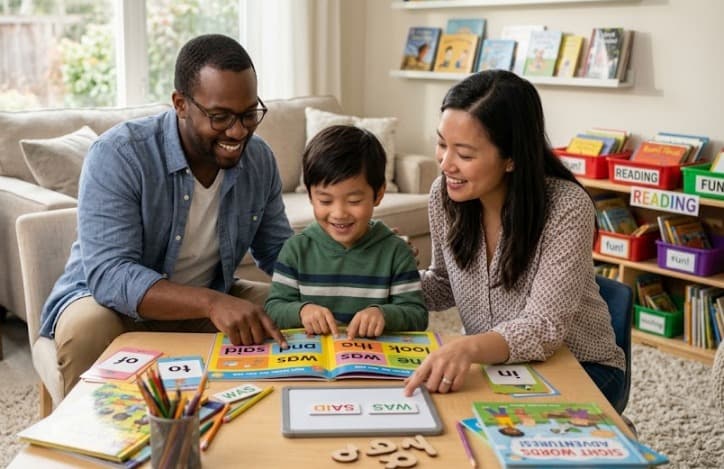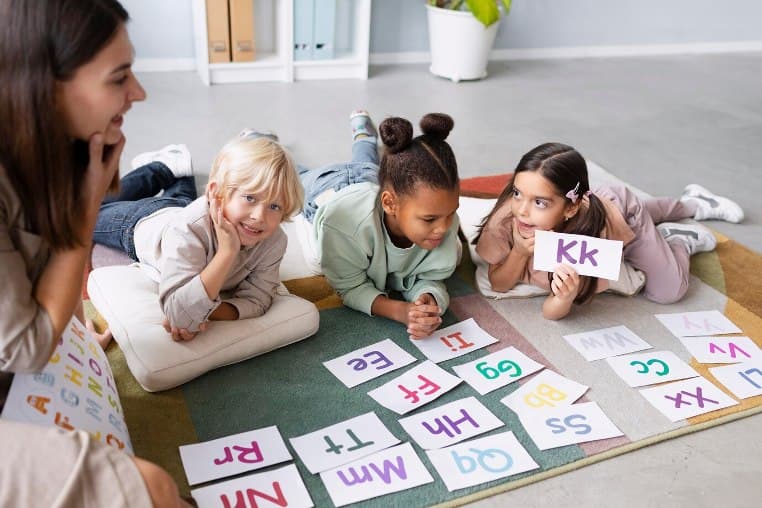
Hands on learning is a teaching approach where children build understanding by touching, moving, building, and testing rather than by listening or reading alone.
It is also called experiential learning or active learning. A child measuring flour for a recipe, sorting rocks by size, or assembling a model volcano is engaged in hands on learning.
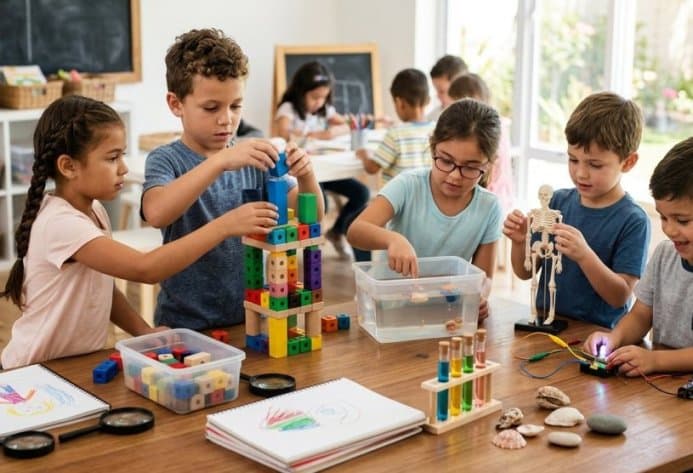
The core idea is simple. Children generate their own understanding through action instead of only receiving information from an adult.
This matters because young children think in concrete terms long before they can reason abstractly.
A child can grasp that five blocks plus three blocks makes eight blocks by physically combining them, well before they can solve the same problem on paper.
Why Children Learn Best Through Hands On Learning
Children learn best through hands on learning because physical action activates more of the brain at once than listening does.
When a child touches, moves, and manipulates an object, sensory input, motor control, and memory systems all fire together. This creates stronger and more durable memories than passive instruction.
Jean Piaget’s theory of cognitive development explains part of this.
The children move through four stages, from sensorimotor exploration in infancy to concrete operational thinking around ages seven to eleven, and that at every stage children build knowledge by acting on their environment rather than absorbing it passively.
During the concrete operational stage in particular, children reason logically about real, tangible objects long before they can reason about pure abstractions.
Recent research backs this up outside the theory. A 2025 rapid evidence assessment of experiential learning in children ages 4 to 14 found consistent academic gains, with the clearest effects in science education where children observed, experimented, and worked with real materials.
The same review found that hands on approaches also strengthened critical thinking and problem solving skills that carried over into other subjects.
How Hands On Learning Affects the Developing Brain
Hands on learning strengthens the developing brain by linking movement, senses, and thinking into one connected experience.
When a child manipulates an object, the motor cortex, sensory cortex, and areas responsible for memory and reasoning all activate together. This cross wiring is part of why physical experience sticks better than verbal explanation alone.
Young children have limited working memory and abstract reasoning ability compared to adults. A concrete object gives the brain something stable to reason about.
Sorting buttons by color, for example, is far easier for a four year old than mentally imagining categories without any physical reference.
This is also why hands on activities work well for children who struggle with traditional instruction, including many children with attention difficulties or language delays.
Movement and touch offer an alternate route into a concept when listening alone does not connect.
How Hands On Learning Builds Motivation and Engagement
Hands on learning increases motivation because children feel ownership over what they discover, rather than simply receiving facts from an adult.
Motivation researchers link this to a sense of control and competence, two factors closely tied to sustained engagement in children.
A study of math classrooms found that students rated hands on activities as more captivating than traditional instruction, and reported higher active engagement and motivation as a result.
Bored or disengaged students are also more likely to disconnect from the material entirely, so the motivational boost from hands on work has a direct effect on how much a child actually learns.
Engagement built this way tends to last. A child who solved a problem by building and testing something remembers the process along with the answer, which makes them more willing to try the next challenge.
Hands On Learning vs Traditional Passive Instruction
The table below compares the two approaches directly.
| Factor | Hands On Learning | Traditional Passive Instruction |
|---|---|---|
| Primary activity | Building, touching, testing, experimenting | Listening, reading, watching |
| Brain systems engaged | Sensory, motor, and cognitive systems together | Mostly auditory and visual processing |
| Best fit for age | Especially strong for children under 12 | Works better as children reach abstract reasoning ages |
| Retention | Higher recall through repeated physical association | Relies more on repetition and memorization |
| Motivation | Generally higher due to sense of control | Can decline without variety or interaction |
| Setup effort | Requires materials and adult guidance | Lower prep, easier to scale in large groups |
Neither approach needs to fully replace the other. Many strong classrooms and homes combine short explanations with hands on practice, so children get both the concept and the chance to test it.
Simple Hands On Learning Activities by Age
Children need different types of hands on activities as they grow. Below are age matched examples parents and teachers can start with today.
- Ages 2 to 4: Sorting objects by color or size, pouring water between cups, stacking blocks, simple cooking tasks like stirring.
- Ages 5 to 7: Building simple structures with instructions, planting seeds and tracking growth, counting and grouping objects for basic math.
- Ages 8 to 11: Science experiments with measurable results, building simple machines, cooking with measured ingredients, map and compass activities.
- Ages 12 and up: Coding projects with physical output, model building with engineering constraints, budgeting exercises with real numbers.
Conclusion
Hands on learning works because it matches how a child’s brain processes the world, through action instead of passive listening.
It works at every age. Toddlers, elementary age children, and teens all benefit, just with different types of activities.
Guidance matters as much as the activity. A few questions before and after turn play into real learning.
You do not need a budget for it. Household items like measuring cups, dried beans, and cardboard work as well as any learning kit.