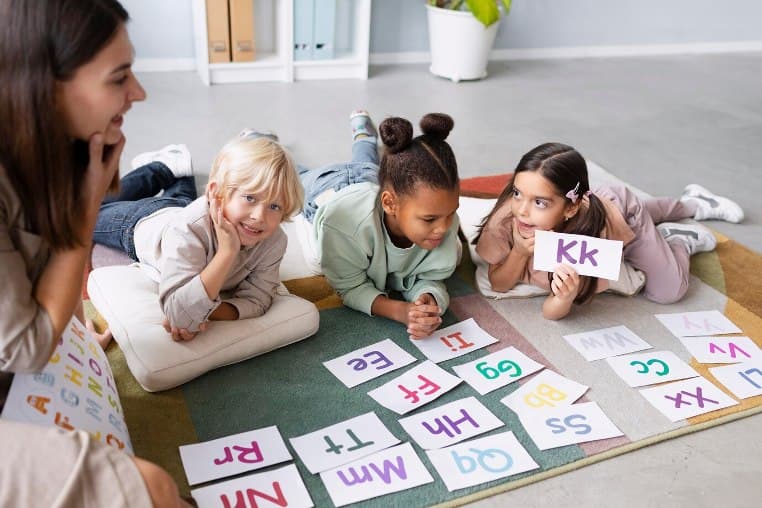
The fastest way to practice sight words at home is to work in short, repeated bursts, five to ten minutes at a time, using games rather than worksheets, and to focus on just five to eight words until your child reads each one instantly.
Sight words are the small, high frequency words like “the,” “was,” and “said” that show up so often in text that children need to recognize them on sight instead of sounding them out every time.
Learning even 100 to 200 of these words lets a child read more than half the words on a typical page.
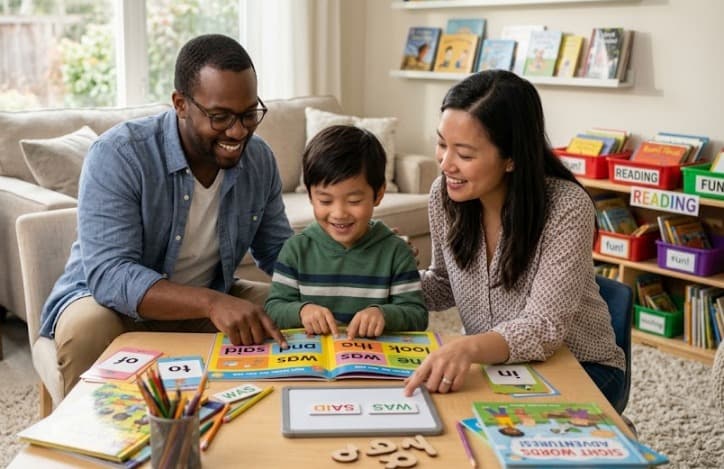
What Sight Words Are and Why They Matter
Sight words are words a reader recognizes instantly, without stopping to sound out each letter. Many of them, like “of,” “was,” and “said,” do not follow regular phonics rules, so decoding them letter by letter does not work well. The child needs to store the whole word in memory instead.
These words matter because of how much of a typical page they occupy. Dolch’s original word list, still widely used today, makes up between 50 and 75 percent of the words in ordinary reading material for children and adults.
A more recent analysis found that just 13 of the most common words already account for about 25 percent of the words a child encounters while reading, and the next 100 to 200 high frequency words push that number past half.
Automatic recognition of that many words frees up a child’s attention for the words that do need sounding out, and for actually understanding the sentence.
It is worth knowing that sight word instruction is one part of learning to read, not the whole approach. Reading researchers and education reporters have noted that sight word memorization works best alongside phonics instruction, which teaches children to decode unfamiliar words by sound rather than by memorizing every word they meet. Home practice should support the phonics instruction happening at school, not replace it.
How to Choose Which Sight Words to Start With
Start with the words your child is already bringing home from school or daycare, since matching home practice to classroom material reinforces what your child is learning in both places.
If no list has come home yet, pull from a widely used set like the Dolch list or the Fry list, both organized by grade level and frequency of use.
Pick five to eight words at a time. That is enough to keep a session focused without overwhelming a young reader.
Once your child reads three or four of those words instantly and without help, swap in one or two new words rather than replacing the whole set at once. This keeps most of each session on words that already feel easy, which builds confidence while still introducing something new.
Favor words your child will see often in the books you read together at home. If you are reading a lot of picture books this month, check which sight words appear repeatedly in those specific titles and prioritize those first.
Simple Sight Word Games for Home Practice
Flashcards work, but games hold attention longer and create more repetitions per minute, which is what actually builds automatic recall. Here are five that need little to no setup.
Sight word hunt. Write each word on a sticky note and hide them around a room. Your child finds a note, reads the word aloud, and brings it back. This works well for children who need to move while they learn.
Fly swatter match. Lay several word cards on a table or tape them to a wall. Call out a word and have your child swat it with a flyswatter or point to it fast. This adds urgency, which many children find motivating.
Sight word bingo. Make a simple grid with nine or sixteen words your child is currently practicing. Call out words one at a time and have your child cover the matching square.
Sidewalk chalk hop. Write words in chalk squares outside. Your child reads each word before hopping onto it, turning practice into a physical game rather than a seated task.
Memory match. Make two cards for each word and lay them face down. Flip two at a time, reading each word aloud, and keep any matching pair. This one doubles as a reading exercise and a memory game.
Rotate between two or three of these across the week so practice does not feel repetitive. The word repeats. The game changes.
See This: Why is Early Reading Bad for Your Child?
Building a Daily Sight Word Routine
Consistency beats intensity for this kind of practice. A five to ten minute session every day builds far more retention than one long session on the weekend, because spaced repetition helps the brain move a word from short term recognition into automatic recall.
Pick a time that already fits into your day, such as right after breakfast or just before bath time, so the practice attaches to a habit that already exists.
Keep the tone light. If your child gets frustrated, stop the session rather than pushing through, since frustration during reading practice tends to build resistance to the next session.
A simple weekly rhythm looks like this:
| Day | Focus |
|---|---|
| Monday | Review last week’s mastered words for two minutes, then introduce the new set |
| Tuesday to Thursday | Play one game per day using the current word set |
| Friday | Quick check: read each word aloud once, no hints |
| Weekend | Point out sight words during regular reading, no formal session needed |
This structure keeps most days short and game based, with one lower pressure check in to see what has stuck.
Signs Your Child Has Mastered a Word (and When to Add New Ones)
A word counts as mastered once your child reads it correctly, instantly, and without sounding it out, on three separate days.
One correct reading is not enough. Children can guess correctly by luck or by remembering the position of a card, so spacing the check across different days and different formats confirms real recognition.
Once three or four words in a set are mastered, retire them to a review pile and add one or two new words.
Keep the mastered words in occasional rotation, checking in every week or two, so the skill does not fade from lack of use.
If a word is not sticking after two or three weeks of regular practice, try connecting it to something concrete.
Use it in a silly sentence, point it out in a favorite book, or trace it in sand or shaving cream. Multisensory practice helps some children where flashcards alone do not.
Conclusion
Sight word practice at home works best when it is short, frequent, and playful rather than long and drilled.
Start with five to eight words tied to what your child is already learning at school, mix flashcards with games and confirm mastery across several days before adding new words.
Combined with the phonics instruction happening in the classroom, a few minutes of daily practice at home adds up to real reading progress over the course of a school year.