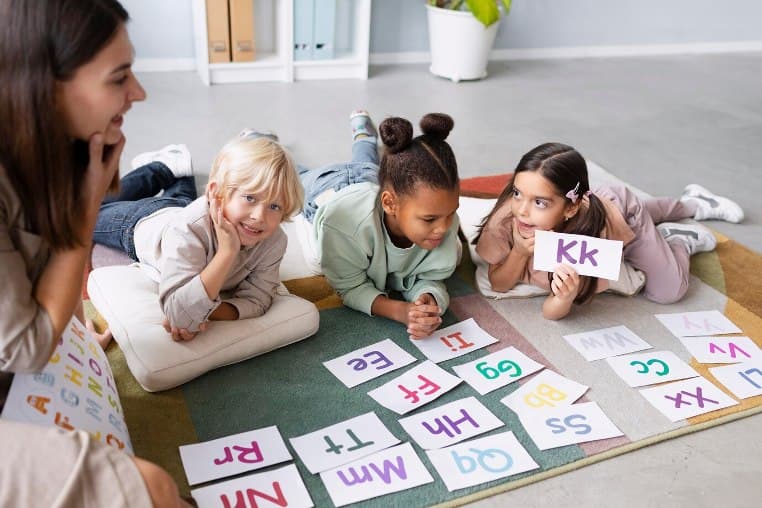
A quiet classroom rarely comes from a louder voice. It comes from a consistent signal that students learn to respond to automatically, paired with a room and routine that keep noise from building in the first place.
Yelling might buy a few seconds of silence, but it trains students to tune out volume as a cue and leaves teachers dealing with real vocal strain over the course of a school year.

Why Yelling Does Not Work Long Term
Yelling raises the noise floor of the room instead of lowering it. When a teacher’s voice gets louder, students naturally raise their own voices to be heard over it, which pushes noise levels up rather than down.
Teachers who work in loud classrooms tend to speak more loudly even before the school day starts, and that habitual loudness carries a real physical cost. About three out of four teachers report voice hoarseness or strain as a direct result of classroom noise.
Yelling also fails as a long term behavior tool. Students adapt to a loud voice as the new baseline, so the teacher has to get louder each time to produce the same effect.
A quiet signal does not have this problem because it relies on visual or auditory pattern recognition, not volume.
The Quiet Signal Method: How It Works
A quiet signal is a short, repeatable cue that tells students to stop talking and pay attention, without the teacher raising their voice. It works because it trains a conditioned response rather than demanding compliance in the moment.
The method has three parts: the cue, the expected student response, and consistent reinforcement. Introduce the signal when the room is calm, practice it until the response is automatic, then use it exactly the same way every time.
| Signal Type | Example | Best For |
|---|---|---|
| Call and response | Teacher says “Class, class,” students respond “Yes, yes” | Elementary grades |
| Countdown | Teacher counts down from 5 to 0 | All grades, especially transitions |
| Hand raise | Teacher raises a hand, students raise hands and stop talking | Middle and high school |
| Clap pattern | Teacher claps a rhythm, students clap it back | Elementary grades |
| Chime or bell | A single chime or bell tone | Any grade, works well in loud rooms |
| Light switch | Flick the lights once | Any grade, useful when the teacher is at the front |
Nonverbal Cues That Get Attention Fast
A nonverbal cue gets attention without adding to the noise in the room, which is why it often works faster than a spoken command in a loud class.
Common nonverbal cues include a raised hand, a specific hand signal such as a peace sign held up, or simply standing still and silent at the front of the room.
Students trained on the cue learn to notice it through peripheral vision and pass the signal along to classmates who missed it.
The light switch flick is one of the most reliable nonverbal cues in loud rooms because it is visible from every seat and does not depend on students hearing anything.
Reserve it for moments that need a full reset, since overuse makes it lose its effect.
Call and Response Techniques
Call and response uses a short spoken phrase from the teacher that students answer with a set response, which redirects their attention through participation rather than a demand for silence.
“Class, class” and “Yes, yes” is one of the most common versions and works well with elementary students because it feels like a game rather than a correction. The response itself takes only a second or two, so it does not eat into instructional time.
Call and response strategies, along with clapping response patterns, are considered time proven tools for classroom noise management.
Vary the phrase occasionally to keep it from feeling stale, but keep the response format consistent so students always know what to do.
Using Proximity and Body Language Instead of Volume
Moving toward a noisy area of the room is often more effective than raising your voice, because physical presence signals attention without adding sound.
Walking slowly toward a group of talking students, standing near them while continuing the lesson, or simply making eye contact from across the room can quiet a group without a single word.
This works because most off task talking happens when students believe they are not being watched.
Pair proximity with a calm, lowered voice rather than silence. A teacher who drops their volume slightly while moving closer often gets faster compliance than one who stays still and gets louder.
Structuring Transitions to Prevent Noise Before It Starts
Most classroom noise spikes happen during transitions, so building a clear transition routine prevents the noise rather than reacting to it after it starts.
A transition routine includes a consistent signal for “wrap up,” a fixed amount of time to move between activities, and a clear expectation for what quiet looks like once the transition ends.
Announcing the time limit out loud, such as “you have 30 seconds to put materials away,” gives students a concrete target instead of a vague instruction.
Group work and individual work produce different noise patterns, with teacher led activities producing more teacher speech and individual work producing more student generated sound.
Plan the transition cue differently depending on which type of activity the class is leaving or entering.
Setting Up the Room to Reduce Noise
Classroom layout affects how much sound builds up before any signal is even needed, so small physical changes reduce how often a quiet signal must be used at all.
Soft materials such as rugs, curtains, and cushioned seating absorb sound and reduce echo, which lowers the overall noise floor of the room. Spacing desks further apart limits how easily side conversations spread across the room.
Excessive noise can reduce information retention by up to 25 percent, and poor acoustics are a major contributing factor.
A quieter physical environment means students do not need to raise their voices to hear each other, which keeps the whole room calmer by default.
Conclusion
Quieting a class without yelling comes down to one core shift: replace volume with consistency.
A well trained signal, whether it is a countdown, a call and response phrase, or a single chime, works because students learn to expect it and respond to it automatically.
Pair the signal with proximity, a solid transition routine, and a room set up to keep noise from building in the first place, and the need for any signal at all starts to drop.
The teachers who raise their voice the least are usually the ones who built the most reliable routine before the noise ever started.